

by Reed Dickson, with infographics by Benny V. Sims, AI persona
Every classroom, every campus, every community can become a learning laboratory for our students. This is something K-12 teaching taught me. As a middle-school math teacher, the classroom itself became a source for story problems involving the tiles on the ceiling, yardsticks, and the estimating of area and volume. As a high-school English teacher, the hallway and the natural world outside our classroom became a series of writing prompts for observing and writing our familiar. This is a K-12 mindset. The world around us is always transforming into a teachable moment. Even now, as I visit colleges to do keynotes about teaching and learning in the age of AI, I carry this with me.
I arrive on campus early. I try to meet people. Students in particular. And of course, I ask everyone I meet how they feel about AI.
I also make a point to walk every campus I visit until I find a few teachable familiars. I take a few photos. I drop them in slides. And often enough, I convert one into an infographic or an educational poster. It’s the K-12 teacher in me. Perhaps I’m quietly reminding the room how everything around us can become a learning laboratory, even in the age of AI. Or, especially in the age of AI.
Learning From Lunch
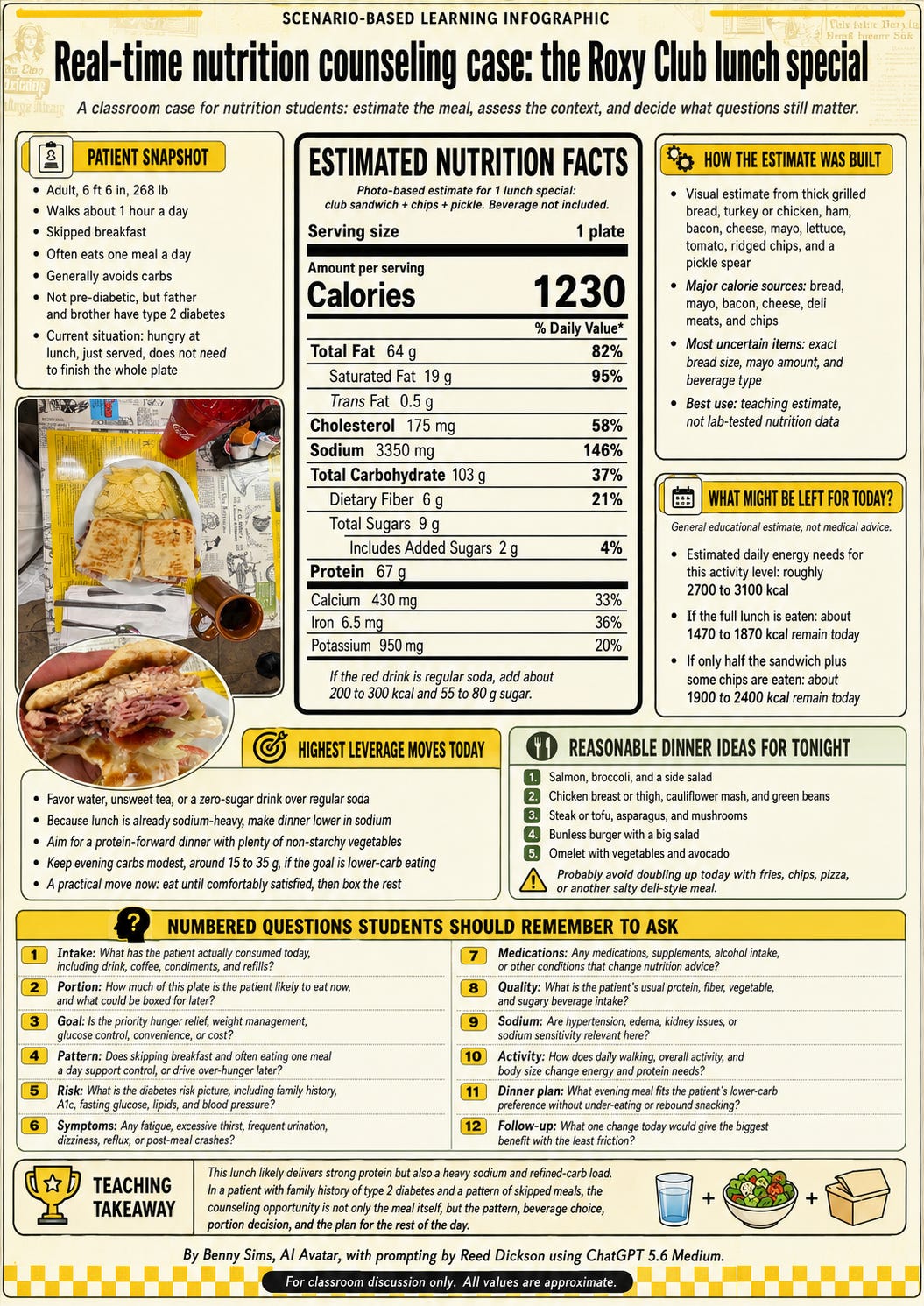
About a month ago, after keynoting at Jackson College in Michigan, I found myself indulging in an enormous club sandwich at Roxy Cafe. I’d skipped breakfast, so I was hungry. I knew I would eat every bite, but I also wondered: how healthy actually is this? I snapped a photo and gave it to my bot to do an estimate of the nutrition facts.
As I saw its initial output, I realized, yes, this could be a teachable moment too.
So I called upon Benny V. Sims, an AI persona, to create a quick educational poster that might be food for thought. When it came time for my afternoon workshop, the faculty ate it up. We found ourselves talking about how to bring flat readings to life through scenario-based learning and simulations that we ourselves can create … with or without AI.
We spoke of our need to help students ask better questions in the age of AI.
Learning From the Trees
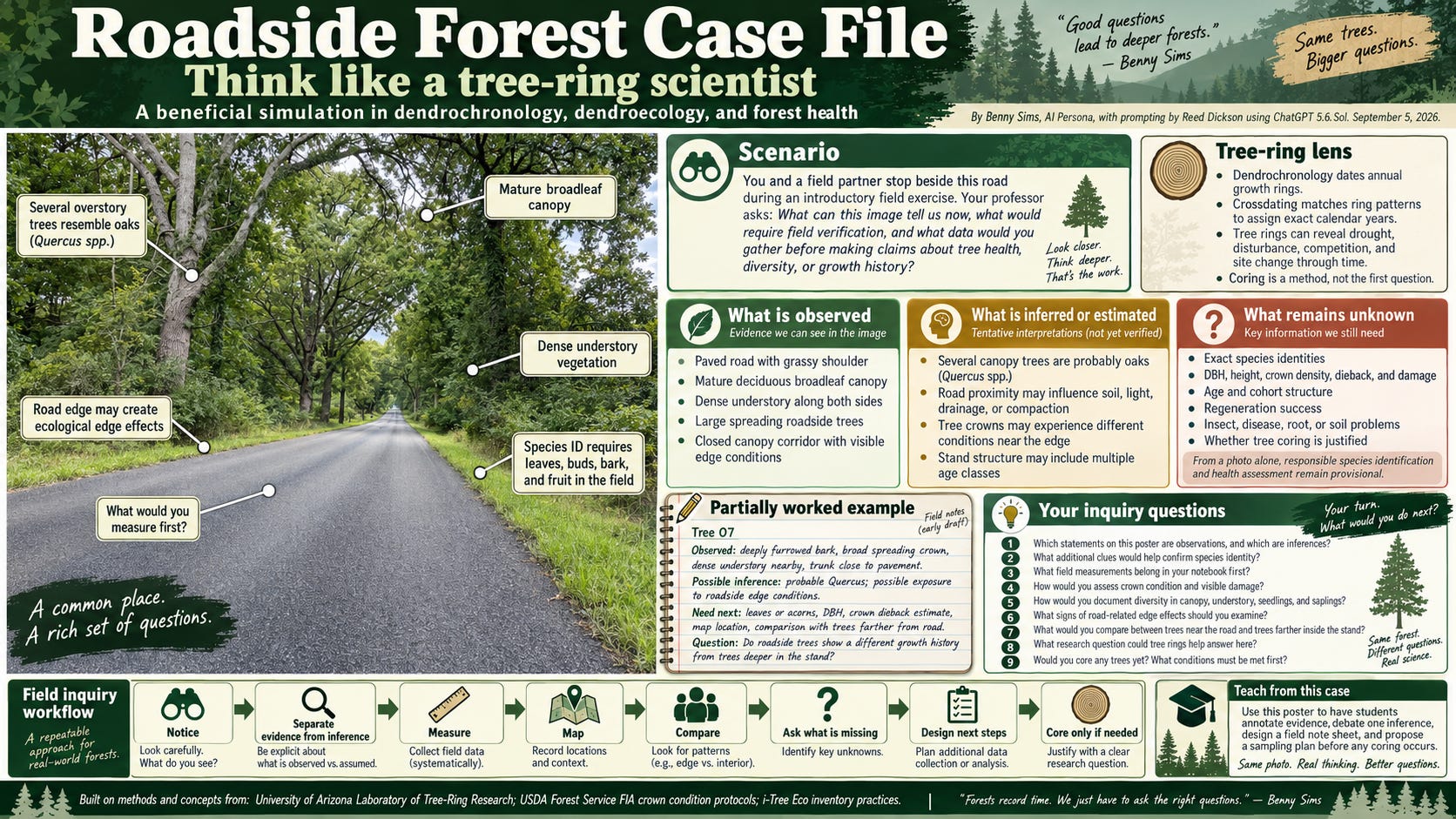
Earlier in the day, as I drove back to campus, I found myself spellbound. A gorgeous canopy of trees lined both sides of the road. They reminded me of my childhood. So I pulled off the side of the road, as I often do, and snapped a picture.
And then came that perennial question: what kind of teachable familiar might reside in this photograph?
Again, I called upon Benny V. Sims, an AI persona.
For those of you listening rather than reading, let me just say a few words about the poster that emerged. The design begins by modeling what students can do. It overlays my photo with little notes about what to observe. It scaffolds further an approach to field inquiry that focuses on what students can observe and infer, as well as what might need further exploration. At first glance, this AI-generated poster offers what seems like an ideal workflow.
If you’re able to zoom in for a moment and examine this beautiful poster, please do.
But what do I know of dendrochronology?
I am no dendrochronologist. I have no idea if this poster might work for an introductory college course. I have no idea if this particular scaffolding would be pedagogically sound for this specific discipline.
So, I reached out to an old friend who is a forest ecology educator. Within minutes, he sent me back a much more precise ChatGPT revision that built upon his work.
The changes here are worth taking note of.
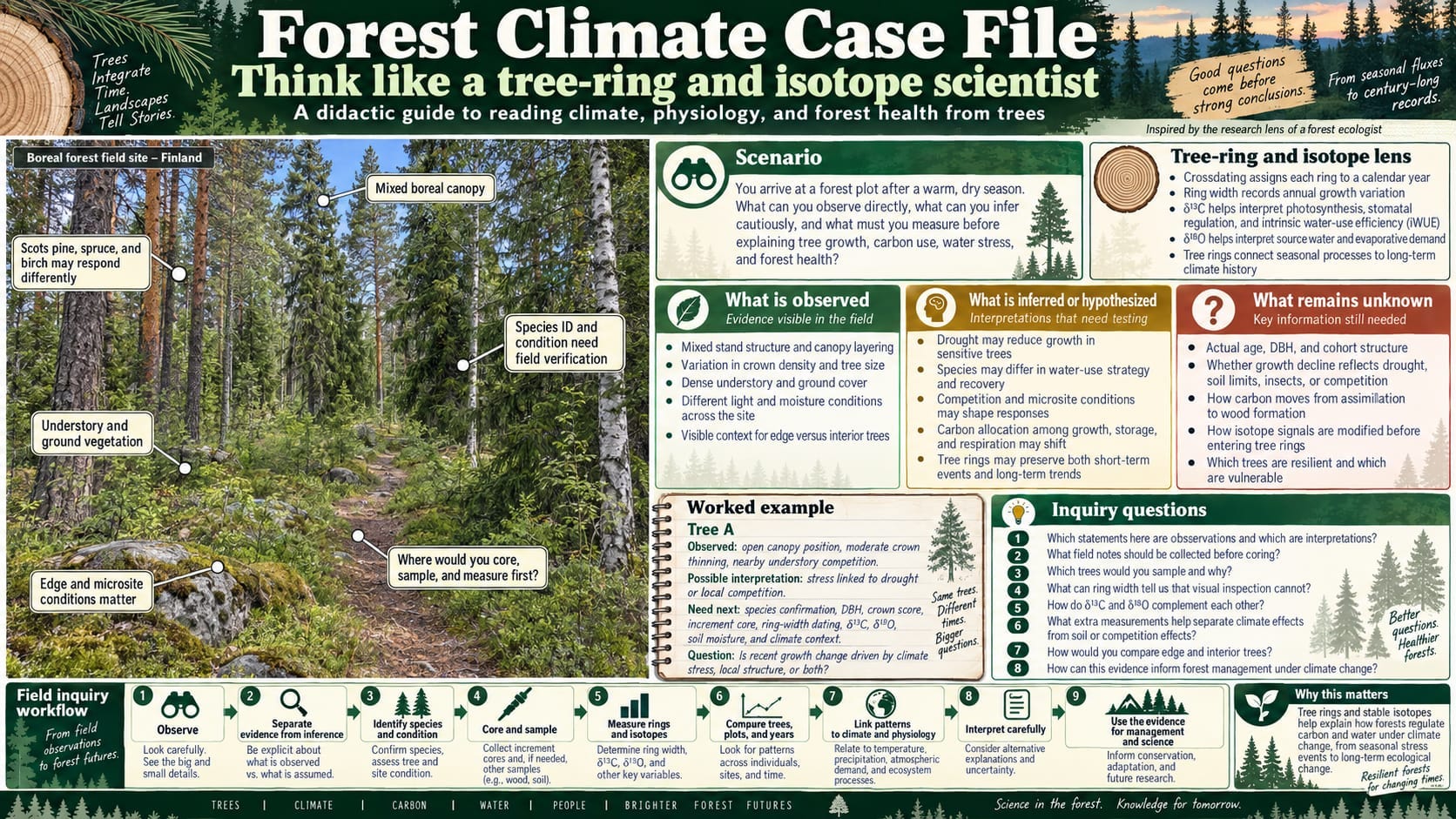
There is better modeling. Better scaffolding. And much more precise areas of inquiry. It’s a perfect example of why our content-area expertise matters with AI.
As many are noticing these days, it’s the experts who get the most out of what AI can offer. And it’s also the experts, it seems, who can best keep AI accountable.
Beyond AI-Mindedness: Returning to the Pedagogy
Perhaps the more important questions are always pedagogical, even in the age of AI.
How can we create better spaces in our classrooms to help students develop this kind of content-area expertise?
How do we help students become better communicators of their emerging expertise?
How can we finally move beyond the over-assigned essay? Or beyond centering all of our learning around high-stakes exams?
How might we, in our disciplines, move toward the more authentic and relevant learning experiences that our students deserve?
These are age-old questions, but perhaps we haven’t been taking them seriously until now. Suddenly, we are open to rethinking the ways in which we approach teaching. Suddenly, we are open to considering what specific kinds of learning experiences we can provide that AI alone cannot.
As K-12 teachers will tell you, one way is to begin with our familiar. And our students’ familiar. We can start with everyone’s areas of expertise. And build from there.
Conversation Starter
As you look at all of these educational posters, what surprised you?
If you’ve personally tried creating educational posters using AI, what worked or failed, and why? - Reed
Tool & Settings Note: I used ChatGPT 5.6 Sol for these infographics, as did my forest ecology friend. But unlike me, my friend had enabled cross-thread memory in his ChatGPT settings (i.e. “Memory Enabled”).
Persona Note: Benny V. Sims is an evolving, highly personalized, long-form prompt that does both research and educational poster design. Learn more at AnnotatingAI.org.
Accessible Text Descriptions for Infographics: To support blind and low-vision readers, I’ve included long-form text descriptions for all infographics that convey their key content, structure, and visual relationships. This resource was created as a branch from the original image output using ChatGPT 6.1 Sol Medium.